
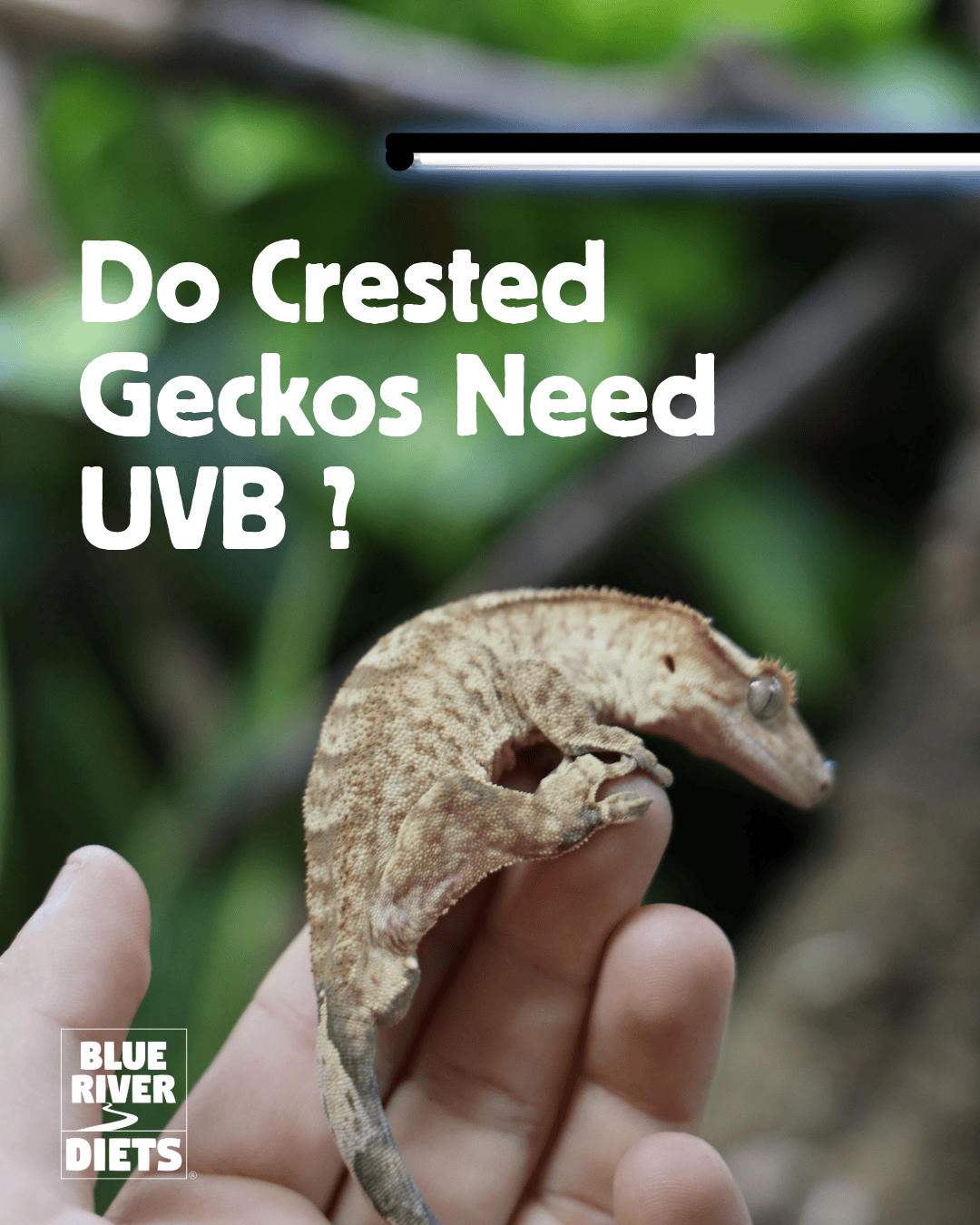
Do Crested Geckos Need UVB?
Few questions in crested gecko keeping have sparked as much debate as this one, and in some parts of the world it remains a contentious topic. For many years the prevailing view was that UVB was unnecessary. Two arguments supported it. First, complete crested gecko diets already supply calcium and vitamin D3. Second, crested geckos were long described as nocturnal, so it seemed reasonable to assume that a species active only after dark had little use for ultraviolet light.
Our understanding of these geckos has developed considerably since then, and so has the way we care for them. That raises a question worth asking: does the traditional advice still stand, or is it time to look at UVB in a new light?
The role of UVB
To answer that, it helps to start with why UVB matters to reptiles at all.
When UVB light reaches a reptile’s skin, it starts the production of pre-vitamin D3, which the liver and kidneys then convert into its active form. Vitamin D3 is what allows the body to absorb and properly use dietary calcium. Without enough of it, even a well-supplemented diet may not deliver its full benefit.
Calcium and vitamin D3 together are fundamental to skeletal health, and an imbalance between them can lead to Metabolic Bone Disease (MBD). MBD is a painful and potentially fatal condition that leaves bones soft, misshapen or brittle. Beyond the skeleton, vitamin D3 also supports muscle function, nerve signalling and a healthy immune system.
Rethinking “nocturnal”
The belief that crested geckos are strictly nocturnal has shaped much of the UVB debate. Today they are more accurately described as crepuscular, meaning they are most active during the twilight hours of dawn and dusk.
Observations from their native New Caledonia support this view. Crested geckos have been recorded active in the wild during the middle of the day, and measurable UV levels have been found within their forest habitat. Clearly, these geckos are not living in total darkness.
Cryptic basking
Our growing understanding of cryptic basking adds further weight to this picture. Cryptic basking describes a reptile exposing only a small part of its body, such as the tail, a limb or the head, to the light while the rest stays concealed in foliage, a crevice or a hollow.
Crested geckos don’t bask openly in the way a bearded dragon would. Even so, as they rest among the branches during the day, they are very likely to receive low levels of UVB filtering through the canopy. Providing a similar, gentle source in captivity is therefore not an unnatural addition. It simply reflects the conditions these geckos have evolved alongside.
More than vitamin D3
The benefits of UVB lighting go well beyond calcium metabolism. A consistent cycle of light and darkness helps regulate a reptile’s whole physiology, and this is just as true for crepuscular species as for diurnal ones.
At the heart of this is the circadian rhythm, the internal clock that tells an animal when to wake, forage, rest and sleep. Light helps keep that clock in step. As darkness falls, for example, rising melatonin levels encourage rest. Over longer periods, gradual changes in day length mark the passing of the seasons and can prompt natural behaviours such as breeding. A stable routine also supports a healthy appetite and regular activity. When that rhythm is disrupted, stress, lethargy and poor feeding can follow.
From surviving to thriving
Crested geckos can survive without UVB when they are fed a high-quality complete diet. Survival, however, has never been the measure of good husbandry. Our understanding of the species has deepened, and appropriate lighting is now more accessible than ever. Taken together, these make a compelling case: UVB is not simply an optional extra, but a meaningful way to help crested geckos thrive, with a captive life that more closely reflects the one nature intended.
Getting the setup right
Providing UVB for a crested gecko is a very different undertaking from lighting a sun-loving species such as a bearded dragon. The aim is not intensity but subtlety: gentle exposure that mirrors the dappled light of the forest canopy.
Crested geckos belong to Ferguson Zone 1, the category for crepuscular and shade-dwelling species that avoid direct, open sunlight. In the wild, this zone corresponds to an average UV Index (UVI) of around 0–0.7, with brief peaks of roughly 0.6–1.4.
In the enclosure, the goal is a gradient. A UVI of roughly 1.0–2.0 at the highest perch should fall away to zero in the shaded lower levels, although some keepers prefer to stay closer to natural Zone 1 values. Because readings vary with bulb, distance and mesh, a UV meter is the most reliable way to confirm what your gecko is actually receiving.
Bulb choice matters just as much. High-output desert bulbs (10.0+/12%+) are far too strong for a shade-dwelling canopy species, so a low-output or shade-dweller option is the right fit. The lamp should sit above mesh rather than behind glass or plastic, both of which block UVB. Finally, dense foliage, cork bark and well-placed hides let your gecko regulate its own exposure, moving freely between light and shade as it would in the wild.
Found this useful?
Share it with your gecko-keeping friends.